Raid: Shadow Legends explained: an independent guide for new players
What Raid: Shadow Legends actually is, how its systems fit together, what the summon odds really mean, and what “free to play” does and does not cover, so you can decide whether it suits you before you install it.
Contents
At a glance
| Developer and publisher | Plarium Global Ltd (“Plarium”)[1] |
|---|---|
| Owner of Plarium | Modern Times Group (MTG), which completed its acquisition of Plarium from Aristocrat Leisure in early 2025[4][5] |
| First released | Mobile in 2018; the PC version followed in 2020[2] |
| Platforms | iOS, Android and PC (Plarium lists Plarium Play, Steam, Epic Games Store and Microsoft Store)[1] |
| Genre | Turn-based collectible role-playing game with random “gacha” summoning[2] |
| Champions | “900+” across 15 factions, according to Plarium at the time of writing[1] |
| Price | Free to download; contains in-game purchases, including random items[1] |
| Age rating | Plarium states 13+ (18+ in Brazil); the rating shown in your app store may differ by country[1] |
Figures such as the number of champions change with every update. Where this guide and Plarium’s own information differ, Plarium’s official information prevails.
What the game is
Raid: Shadow Legends is a turn-based fantasy role-playing game made by Plarium. You collect characters called champions, build teams (usually four or five champions, depending on the mode) and send them into fights. Those fights are decided by stats, skills and turn order. Speed and timing of taps don’t matter. Most battles can be run on automatic once your team is strong enough. The skill lies in choosing, building and combining champions.
It is a gacha game: most new champions come from opening “shards”, which give a random champion with fixed odds for each rarity. That one design choice shapes nearly everything else, from how progress feels to where the game makes its money. It is explained in detail below and in our summoning guide.
The game is long-term by design. There is no ending to reach. Progress means slowly strengthening an account over weeks and months so that harder bosses and higher arena tiers become reachable.
The core loop
Almost everything in the game feeds a single cycle. Battles pay out resources. Resources pay for summoning and for improving champions. Stronger champions unlock harder battles with better rewards.
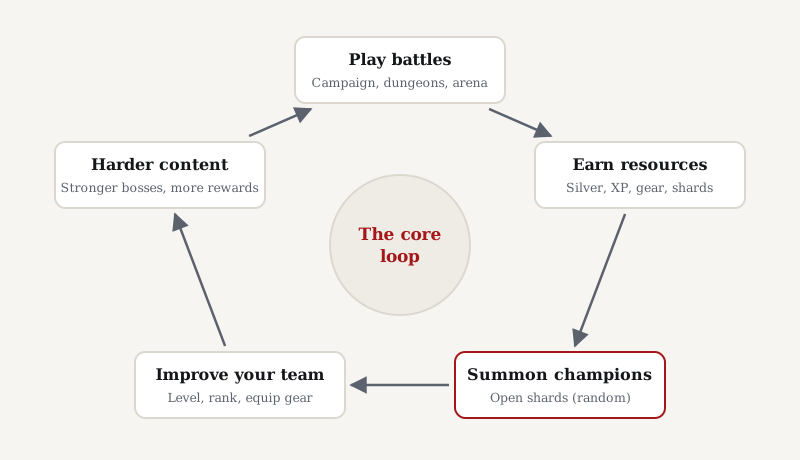
Understanding this loop helps you judge offers and events: most purchases in the game speed up one step of it, usually summoning or improving your team. None of them unlocks content that you could not, in principle, reach by playing, but the difference in time can be very large.
Champions, rarities and affinities
Rarities
Champions come in rarities: Common, Uncommon, Rare, Epic and Legendary, plus a small set of Mythical champions introduced later[2]. Higher rarities generally have stronger or more specialised skills, but many Rare and Epic champions stay useful for the entire game. Community guides consistently point out that a well-built Epic often beats a poorly built Legendary.
Factions
Each champion belongs to one of 15 factions[1]. Factions matter mainly for Faction Wars, a mode where you may only field champions from a single faction, and for some faction-specific bonuses.
Affinities
Every champion also has one of four affinities, which work like rock-paper-scissors:
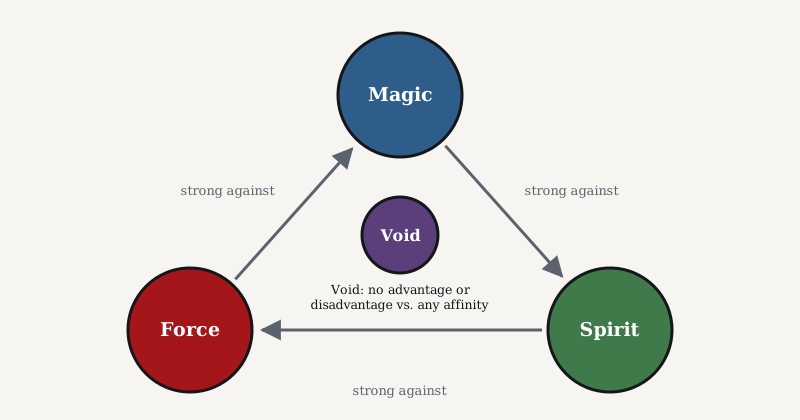
Attacking an affinity you are strong against gives a chance of a “strong hit” that deals extra damage. Attacking one you are weak against brings a chance of “weak hits” and of your debuffs failing to land. Several dungeons and bosses rotate or fix their affinity, so a varied roster pays off.
Team roles
Each champion has a role that tells you which stat its damage and effects scale from:
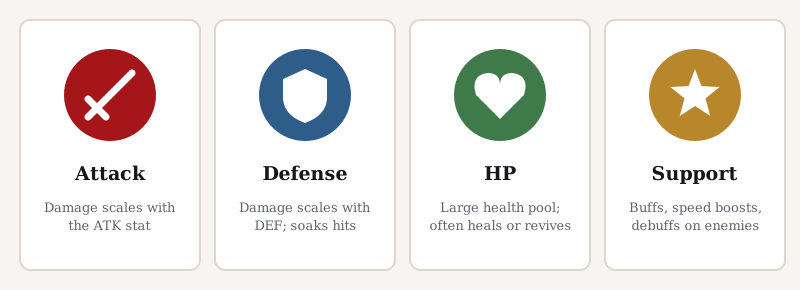
A typical early team mixes one or two damage dealers with a champion who heals or shields and one who applies debuffs such as decreased defence. Once you get past the first chapters of the campaign, Speed becomes the most important stat for most teams, because it decides who acts first and how often.
Gear, levelling and ranking
Champions grow in three separate ways, and new players often confuse them:
- Level goes up with experience from battles. A champion’s maximum level depends on its rank.
- Rank (shown as stars, up to six) is raised by combining a champion with other champions of the same rank. Low-value champions used this way are known in the community as “food”. Ranking is the main long-term sink for your time and silver.
- Gear: champions equip artifacts (weapon, helmet, shield, gloves, chest, boots) and, at higher ranks, accessories. Pieces belong to sets that grant bonuses when combined, and each piece can be upgraded with silver.
Later systems add masteries (a skill-tree of passive bonuses), ascension and blessings. You do not need to understand these on day one. Gear is where most early-game strength comes from, and the gear dungeons are where you farm it.
Game modes
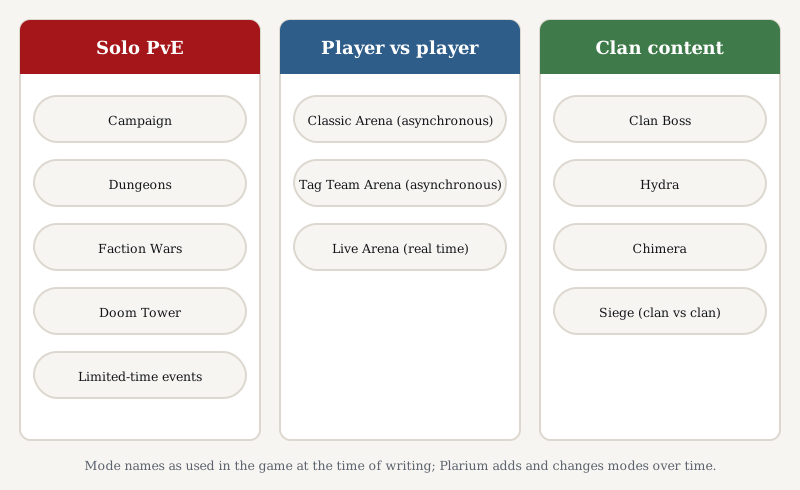
Plarium describes the game as having ten PvE and PvP modes[1]. They fall into three groups:
Solo PvE
The Campaign is a sequence of stages that introduces enemies and mechanics and is the main source of experience early on. Dungeons are repeatable boss fights. Plarium’s list includes Fire Knight’s Castle, Ice Golem’s Peak, Spider’s Den and Dragon’s Lair[1]. Each is the main source of a particular type of gear or upgrade material. Faction Wars restricts you to one faction per stage. The Doom Tower is a multi-floor challenge with its own bosses and rewards.
Player versus player
In Classic Arena and Tag Team Arena you attack other players’ saved defence teams, which the game controls. The other player is not online and not making decisions. Live Arena is the real-time mode: both players are online, draft their champions in turn and choose each action live. Arena rewards depend on your tier and are reset on a schedule.
Clan content
Players join clans (the game’s name for guilds). Clan members each fight the shared Clan Boss daily, and higher-level clans take on Hydra and Chimera. Siege is a clan-versus-clan mode[2]. Joining an active clan early gives you access to rewards you cannot earn solo.
Summoning and the odds
Most champions come from shards. The type of shard determines the odds of each rarity:
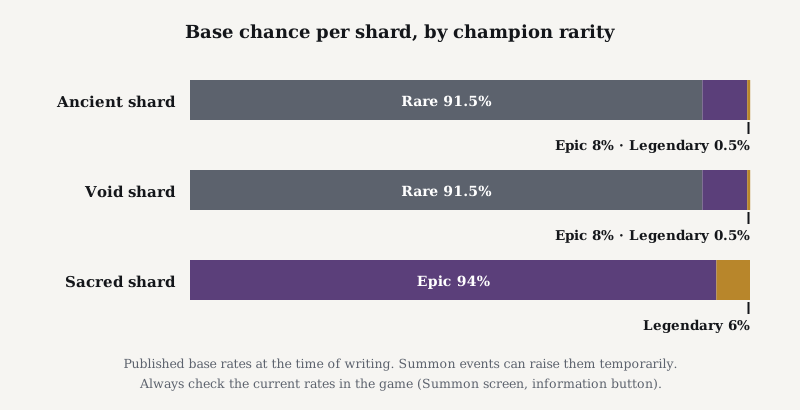
A 0.5% chance means that, on average, one Ancient shard in 200 gives a Legendary, but luck varies a great deal. Without any extra rule, the chance of getting at least one Legendary from 100 Ancient shards is only about 39%, and from 200 shards about 63%. The game adds a mercy rule that raises the odds after a long unlucky streak[3][6]:
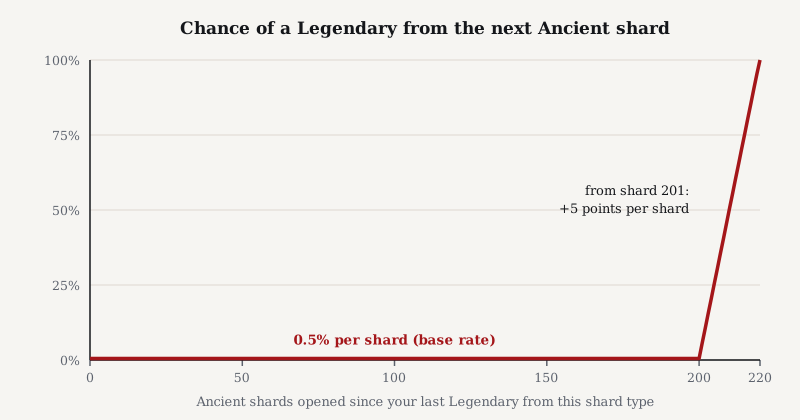
For Sacred shards, the documented rule adds 2 percentage points per shard after 12 in a row without a Legendary. Counters are tracked separately for each shard type[6]. Plarium’s help centre has an article on the mercy system[3]; mercy thresholds are the kind of detail that can change, so treat the numbers above as a snapshot, not a promise. Our summoning guide works through the maths.
Energy and time
Most PvE battles cost energy, which refills slowly over time and can also be earned from quests or bought. Energy is the game’s main pacing tool: it limits how much you can progress per day without spending. Arena battles use separate tokens, and the Clan Boss uses its own daily keys.
The game offers auto-battle and multi-battle features, so much of the repetitive farming can run with little attention. Even so, keeping up with daily quests, clan duties and events takes a regular time commitment. Be honest with yourself about whether you want a daily routine, not an occasional pastime.
Is it really free?
The game is free to download and you can play all of its modes without paying. That is true, but it is not the whole picture:
- The game contains in-game purchases, including random items[1]. Shards are exactly that: you pay (with in-game currency or real money) for a random result.
- Progress without spending is slow, and the most demanding content is realistically reached only after a long time of free play.
- Many offers are time-limited and presented as bundles. Some champions are, at particular times, easiest or only available through paid offers or specific events. Being able to play all modes is not the same as being able to collect every champion for free.
- The game uses several currencies (such as silver and gems), which makes the real-money cost of an item harder to see at a glance[2].
None of this makes the game unusual among gacha titles, but it is worth knowing before you start. See our guide to in-game spending and parental controls for practical safeguards.
Partner link: if you install the game through it, the publisher may earn a commission. It costs you nothing extra. The game is free to download and contains optional in-game purchases, including random items.
Is it for you?
You may enjoy it if you…
- like planning, optimising stats and building teams;
- want a game you can play in short daily sessions over months;
- enjoy cooperative goals with a clan;
- are comfortable with randomness in rewards.
You may not if you…
- want a story-driven game with an ending;
- prefer action or reflex-based gameplay;
- dislike time-limited offers and random rewards;
- find it hard to keep in-game spending to a budget.
We don’t give the game a score or a star rating. Whether a long-running gacha RPG is “worth it” depends on what you want from a game, and we would rather give you the facts to decide.
Tips for new players
- Focus your resources. Level and gear one core team rather than spreading silver across many champions.
- Prioritise Speed on gear. Once you get past the early chapters, Speed usually matters more than raw damage.
- Join an active clan early for Clan Boss rewards and advice from experienced players.
- Do the daily and weekly quests. They are the most reliable free source of shards and energy.
- Don’t judge champions by rarity alone. Check a community guide before feeding or discarding an Epic.
- Save shards for summon events if you are patient, because temporary events raise some odds.
- Decide a spending budget before you start, including zero, and stick to it.
Tips describe common practice among players. They do not guarantee any particular outcome, and the game is regularly rebalanced.
Playing responsibly
Random paid rewards can make it easy to spend more than you intended. If you play, or if a child in your household plays, use the purchase controls built into your phone or app store. Check the age rating shown in your store. Plarium’s own stated rating is 13+[1]. If you feel that gaming or spending is getting out of control, talk to someone you trust or to a support service in your country.
Partner link: if you install the game through it, the publisher may earn a commission. It costs you nothing extra. The game is free to download and contains optional in-game purchases, including random items.
Corrections
An earlier version of this page contained claims we could not support or that were wrong. On 24 September 2026 we corrected them:
- The game was first released on mobile in 2018, not 2019.
- The number of champions is 900+ according to Plarium, not “over 300”.
- Classic Arena is not real-time. Only Live Arena is.
- The game has clans, not “guilds”, and there are no modes called “Guild Wars” or “Champion Arena”.
- Players cannot trade champions with each other.
- “All champions can be obtained through in-game progression” was too strong. Some champions are tied to paid offers or specific events at particular times.
- We removed claims we could not verify, including an orchestral soundtrack, availability in “more than 150 countries”, monthly release cadence and “console-quality” graphics, and we removed a “starter bonus” we could not confirm.
- The page was previously labelled as a “reader story”. It is an editorial guide written by our editor, not a reader submission.
To report an error, see our corrections procedure.
Sources
All sources were accessed on 24 September 2026. Where they differ from Plarium’s current official information, Plarium’s information prevails.
- Plarium, “RAID: Shadow Legends” game page (official). plarium.com/en/game/raid-shadow-legends/
- Wikipedia, “Raid: Shadow Legends” (secondary source). en.wikipedia.org/wiki/Raid:_Shadow_Legends
- Plarium Help Center, “Mercy system” (official). raid-support.plarium.com
- MTG, press release “MTG completes the acquisition of Plarium and becomes a scaled midcore gaming leader”. mtg.com
- PocketGamer.biz, “MTG completes $620m acquisition of Raid: Shadow Legends developer Plarium”. pocketgamer.biz
- Community documentation of shard odds and mercy thresholds (unofficial): AyumiLove, “Raid Shadow Legends Mercy System Explained” (ayumilove.net), and HellHades (hellhades.com).
About this page
Visuals. All illustrations and diagrams on this page are original works created by teneris.online as SVG graphics. They are not screenshots, official artwork or stock images, and do not reproduce any game assets.
Trademarks. teneris.online is not affiliated with, endorsed by or sponsored by Plarium Global Ltd, Modern Times Group or any other company mentioned. “RAID: Shadow Legends” and “Plarium” are trademarks of their respective owners and are used here only to refer to the game.
Purpose. This guide is for general information. It is not financial advice. Game content, odds and offers change; check the game and Plarium’s official channels for current details.